Key takeaways
- Most pallet conveyor rework is decided before design starts: a missing workpiece weight, tooling weight or ceiling height will surface later as drilling, re-wiring or a line that cannot accumulate.
- Select the line by total load per section — pallet tare + workpiece + tooling + accessories — not by workpiece weight alone.
- Light duty (≤250 kg per section): BC2 timing belt, FC2 flat belt and PC2 plastic chain. Heavy duty (300–2,500 kg): the AC accumulated chain family.
- Acceptance is a test sequence, not a signature: no-load run, full-load run, then speed, positioning, transfer and safety checks, one by one.
A pallet conveyor line looks simple — pallets moving between stations — but it is the material-flow backbone of the workshop. In new energy battery, electronics (3C) and automotive parts plants, a line that needs rework after installation costs far more than the conveyor itself: stations wait, takt time slips, and modifications on a live floor are always harder than changes on a drawing.
This guide is the workflow our engineers follow at Vitrans when we design a custom line on our standardised modular pallet conveyor range. If you are planning a line, you can use it in two ways: as a design checklist for your own team, or as the brief you send to a conveyor supplier. The more of Section 1 you can answer, the fewer changes you will pay for later.
1. Requirements Discovery: The Step That Determines Whether Rework Happens
In our project reviews, late modifications almost never come from the conveyor itself. They come from information that was missing at the start — a fixture that was heavier than the workpiece, a lifter that does not fit under the ceiling, a cleanroom that was never mentioned. Work through these five dimensions before anyone opens CAD.
1.1 Workpiece and pallet
Vitrans uses two standard pallet families:
- WA2 pallets — used with flat belt, timing belt and flat-top chain lines.
- WE2 pallets — used with roller chain and accumulated chain lines.
Standard pallet sizes run from 160 × 160 mm to 1,200 × 1,200 mm.
Two points engineers miss most often:
- Calculate with total pallet load, not workpiece weight. Add the pallet tare weight, tooling/fixture weight and accessories such as RFID carriers. A 15 kg workpiece on a 10 kg fixture is a 25 kg+ design load before the pallet itself.
- Flag surface requirements now, not later. Anti-static (ESD) protection for electronics, anti-scratch surfaces for cosmetic parts, and heat or oil resistance all change pallet and belt material choices. Retrofitting them means replacing pallets, not adjusting them.
Engineer’s note — the rework we see most: a customer specifies the workpiece weight but not the fixture. The line is built, the fixture arrives at commissioning, the section is overloaded, and drives have to be added. Send the fixture drawing with the enquiry.
1.2 Conveying conditions
Standard rated speeds are 6, 9, 12, 15 and 18 m/min, with a variable frequency drive (VFD) if you need stepless adjustment between steps. Confirm:
- Process type: single-pallet intermittent processing, or multi-pallet accumulation (buffering) in front of a slower station? Accumulation changes the drive type and the stopper specification.
- Section length: under 6 m is a short section; 6–15 m is a standard long section. For runs over 15 m, split the line into driven sections or move to a long-run model (see Section 2) — do not simply extend a short-section design.
- Direction: does any section need to run in reverse? This alone rules some line types in or out (see FAQ).
1.3 Supporting functions
List every function the line must perform, station by station:
- Precise positioning at a station
- 90° direction change
- Transfer between parallel lines
- Vertical transfer between levels
- Diverging and merging flows
Each maps to a standard module — PU lift-and-locate units, PR rotary units, CV/KV curve units, ET lift-and-transfer units and LP lifters. Confirming them at this stage is cheap. Adding one later usually means cutting the frame, re-drilling and re-wiring on site.
1.4 Workshop environment
The standard operating temperature range is +5 °C to +40 °C. Outside this range, rated load capacity must be de-rated — tell the supplier if the line runs in a cold store or next to a heat process.
- Clean / low-dust electronics workshops: prefer low-dust lines — PC2 plastic chain or BC2 timing belt.
- Oily workstations: accumulated roller chain tolerates oil better and can be fitted with automatic lubrication.
- Impact and vibration: keep the line away from punch presses and similar high-impact equipment, or specify isolation in the layout.
1.5 Site infrastructure
Confirm ceiling height (critical for lifters and curves), floor load capacity, and power supply — Vitrans drives are specified for 220/380 V AC, 50 Hz; export projects should confirm local voltage and frequency at this stage, not at shipping. Reserve installation and maintenance access space around large components such as curve units and lifters.
Send your supplier this minimum brief: pallet size · total load per pallet (workpiece + tooling + pallet) · number of stations and function per station · total line length and layout sketch · required speed/takt · environment (cleanroom, oil, temperature) · ceiling height and power supply. Sections 2–5 below show how each item is used.
2. Pallet Conveyor Selection Table: Match Model to Load and Length
The full Vitrans pallet conveyor range is modular, so most custom lines are assembled from standard sections rather than designed from scratch. Use this table to shortlist, then confirm the final configuration against the product page for that model — ratings are per section and must still be checked against your pallet, tooling and station layout.
| 모델 | Drive / medium | Max. load per section | Compatible pallet | Max. section length |
|---|---|---|---|---|
| BC2 | 타이밍 벨트 | 60kg | WA2 | ≤ 6 m |
| FC2 | 평벨트 | 250 kg | WA2 | ≤ 15 m |
| PC2 | Plastic chain | 150 kg | WA2 | ≤ 8 m |
| AC2 / AC2U | 적층 롤러 체인 | 300 kg | WE2 | ≤ 6 m |
| AC2L | 적층 롤러 체인 | 700 kg | WE2 | ≤ 15 m |
| AC2/H | 적층 롤러 체인 | 2,200 kg | WE2 | ≤ 15 m |
| AC4/H | 적층 롤러 체인 | 2,500 kg | WE2 | ≤ 20 m |
Source: Vitrans product specifications, checked November 2026 against the BC2, FC2 and PC2 product pages. Line rating is not pallet rating: a section rating is the total moving load the section can carry, shared across the pallets on it.
3. Choosing a Line Type by Application
Light duty (up to 250 kg per section)
- BC2 timing belt conveyor — sections up to 6 m, 60 kg rating, supports forward and reverse running. Quiet, no slip, well suited to clean assembly of small parts. Standard drive 0.2 kW.
- FC2 flat belt conveyor — up to 15 m and 250 kg, one direction only. The economical choice for long-distance transfer of large, light workpieces; the belt also allows pallet accumulation.
- PC2 plastic chain conveyor — up to 8 m, 150 kg, low dust generation. Commonly used where cleanliness matters, such as precision small-parts and electronics assembly.
Medium to heavy duty (300–2,500 kg per section)
The AC accumulated chain family carries the heavy work in battery and automotive plants:
- AC2 / AC2U: short sections ≤ 6 m, 300 kg.
- AC2L: up to 15 m, 700 kg.
- AC2/H: 2,200 kg, for large automotive workpieces.
- AC4/H: 2,500 kg, sections up to 20 m.
Wear strips come in plastic (rated 1.5 kg/cm) and steel (2 kg/cm). For heavy loads, specify steel — the price difference is small against the cost of replacing worn plastic strips under load.
Special conditions
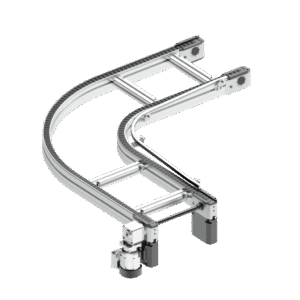
- 90° / 180° direction changes: KV / CV curve units.
- Multi-level transfer: LP lifters (timing belt or rodless cylinder).
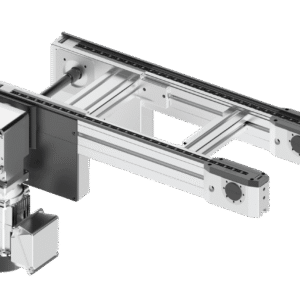
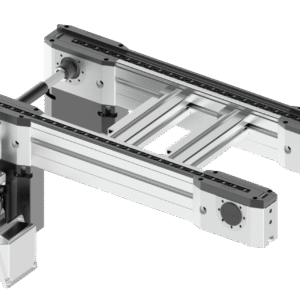
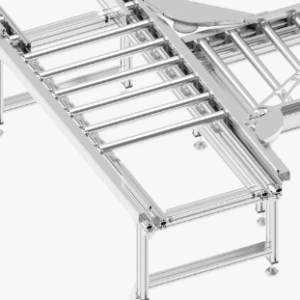
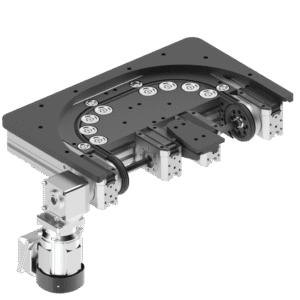
- Transfer between parallel lines: ET series lift-and-transfer units — for example the ET2/B transverse unit used in loop layouts, which sits flush in the line and lifts the pallet sideways onto the return lane.
4. A Worked Load Calculation
This is the calculation we ask every customer to do with us before model selection:
Total load per section = (pallet tare + workpiece + tooling + accessories) × number of pallets on the section
Worked example — a battery module assembly station:
- Pallet (640 × 640 mm WE2): 12 kg
- Workpiece: 28 kg
- Welding fixture/tooling: 9 kg
- RFID carrier and sensors: 1 kg
- Load per pallet: 50 kg
- Longest section holds 8 pallets in accumulation: 8 × 50 kg = 400 kg per section
400 kg rules out BC2, FC2 and PC2 on that section, and AC2 (300 kg) is too close to its limit. The correct shortlist is AC2L (700 kg), which leaves headroom for a heavier future product variant — headroom you will want the first time the product changes. If the same calculation had come out at 45 kg per section with 1–2 pallets, a BC2 timing belt line would have done the same job at lower cost and noise.
Rule of thumb: if your calculated section load is above 80% of a model’s rating, step up to the next model or add an intermediate drive. Running continuously at the rating is how chains stretch and belts wear early.
5. Detailed Design: Frame, Drive, Guidance, Stations, Controls
5.1 Frame
- Light and medium duty: 40 × 80 mm aluminium profile frames — flexible to assemble and easy to modify if a station moves.
- AC2/H and AC4/H heavy duty: thick-walled welded square tube.
- Manual workstation height is typically 750–850 mm, on adjustable levelling feet. Heavy-duty lines use large anti-slip feet and must be anchored where floor condition requires it.
5.2 Drive
Typical sizing: 0.2 kW for BC2/PC2 light-duty lines, 0.75 kW for FC2, 0.4 kW for AC2L, 0.75 kW and above for AC2/H and heavier. For high-precision transfer and lifting, prefer servo drives over standard three-phase motors — the positioning repeatability, not the power, is the reason.
5.3 Load and guidance
- Belt lines: fit self-aligning idlers to prevent belt wander.
- Roller chain lines: RH3 automatic lubrication units reduce the most-skipped maintenance task on chain lines.
- Pallets wider than 400 mm: specify pin-reinforced side frames.
5.4 Station mechanisms
- General positioning: PN guide plates, about ±0.5 mm — enough for manual and semi-automatic stations.
- Precision stations: PU lift-and-locate units with pin-and-bushing location, down to ±0.05 mm — for robotic handling, pressing and testing.
- Direction change at a station: PR rotary units.
Guard all drive components, and place emergency stops to the site’s safety assessment — conveyor safety requirements (for example under ISO 12100 machinery risk assessment principles) are the customer’s and integrator’s joint responsibility, so agree stop positions and guarding in the layout review, not at acceptance.
5.5 Electrical and pneumatic
- PLC control with touchscreen HMI, VFD speed control for the full line, photoelectric and proximity sensors at every stopper and transfer.
- Cables in trunking or cable chains — never loose along the frame; this is both a safety and a troubleshooting issue.
- Pneumatics: standard FRL unit; oil-free air preparation for cleanrooms. Cylinders with flow controls for cushioning and noise reduction; valve banks grouped centrally so a technician can reach every valve from one position.
Three pre-build checks that prevent hidden failures
- Load check — calculate total load section by section (Section 4). Never exceed the section rating; add intermediate drives instead of hoping.
- Stability check — keep the pallet’s centre of gravity centred, with CG height no more than half the pallet width, or pallets will sway and mislocate at start/stop.
- Maintainability check — leave working space to replace belts, wear strips and chains. Do not place profile joints at lift or stopper positions; you will regret it at the first strip change.
6. Common Selection Questions
Q: What if a custom line is longer than 15 metres?
Split it into driven sections, or select a long-run model — FC2 flat belt (to 15 m per section) or AC2L accumulated chain — to reduce joints. A single over-long section sags in performance long before it fails outright.
Q: Do I have to use a timing belt conveyor for precise pallet positioning?
No. An accumulated chain line with a PU lift-and-locate unit and pin-and-bushing location also reaches ±0.05 mm. The timing belt’s real advantages are quiet running and zero slip; choose it for those, not for positioning alone.
Q: Cleanroom or oily workshop — what changes?
For cleanliness and low dust, choose PC2 plastic chain or BC2 timing belt. For oily, heavy-duty areas, accumulated roller chain is the safer choice — specify automatic lubrication (RH3) and enclosed guarding.
Q: What if the line must run in reverse frequently?
BC2 timing belt supports forward and reverse. FC2 flat belt is one-directional only. Roller chain reverse running is limited by section length and load; return loops often use a drive at each end or switch that section to belt. Decide this in Section 1 — it cannot be fixed economically afterwards.
Q: How long does a custom pallet conveyor line take to deliver?
Because the line is assembled from standardised modules, design and fabrication are substantially shorter than a from-scratch build. Confirm the current lead time with your project engineer when the layout is frozen — lead time depends on section count, functional units and export packing, and any figure quoted before the layout exists is a guess.
Q: What information do you need to quote a line?
The minimum brief at the end of Section 1: pallet size, total load per pallet, station list with functions, line length and layout sketch, speed/takt, workshop environment, ceiling height and power supply. With those eight items, a supplier can return a model selection and layout proposal instead of a list of follow-up questions.
7. Delivery, Installation and Site Acceptance
Vitrans Automation designs and manufactures modular pallet conveyor systems in Dongguan, China — timing belt, flat belt, accumulated chain, roller and plastic chain lines, with lift, transfer, curve and positioning units — for new energy lithium battery, automotive parts, 3C and semiconductor production. Custom projects follow four steps:
- Drawings — general arrangement, fabrication details, electrical and pneumatic schematics, with the full model designation on every section so spare parts can be ordered years later without guesswork.
- Procurement and fabrication — profiles and standard units as complete sets; belts and wear strips supplied with small spare stock from day one.
- 설치 — level the frame first, then fit conveying media and functional modules, then connect electrical and pneumatic services. Levelling first is not a preference; a frame levelled after fitting will move every stopper position.
- Commissioning and acceptance — in this order, with the customer present:
- No-load run: direction, noise, belt/chain tracking
- Full-load run at rated section load: start/stop behaviour, accumulation
- Speed verification at each rated step used in production
- Positioning repeatability at precision stations
- Every transfer, curve and lift function, cycled repeatedly
- Safety: every emergency stop and guard switch, tested individually
The short version
A reliable pallet conveyor line is not a catalogue purchase and not a from-scratch invention. It is real site requirements (Section 1), checked with a real load calculation (Section 4), matched to proven standard modules (Sections 2–3), and proven at acceptance test by test (Section 7). Do those four things and rework becomes the exception, not the plan.
Planning a line? Send us the eight-item brief from Section 1 — pallet size, total load, station functions, length/layout, speed, environment, ceiling height and power — and our engineers will return a model selection and layout proposal. Contact the Vitrans engineering team or browse the full pallet conveyor range first.