










Reading time: about 9 minutes
Key takeaways
Loud pallet knocks, dented pallet edges and shifting workpieces during accumulation are almost never a load-capacity problem — on a 30 kg motor line they cannot be. They are a zone pressure and cushioning problem.
The fix is usually not a different drive: split the accumulation into zero-pressure zones, turn the accumulation force down, and cushion the stop. Drive choice comes second.
Drive choice is still decisive for life and maintenance: O-belt for light, clean, low-frequency work; sprocket chain for heavy, dirty, high-frequency work; gear (including bevel-gear main shaft) for heavy, synchronised, low-maintenance lines.
Judge a supplier by whether they state the accumulation force and zone logic in the quotation — not by the drive name alone.
The Case: A Motor Line That Knocked From Day One
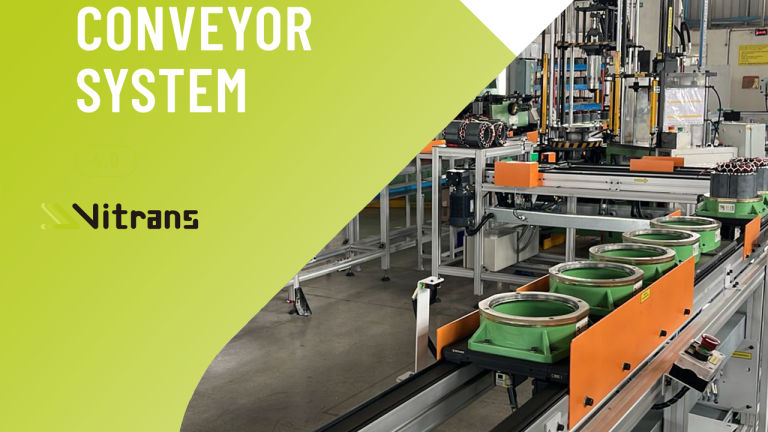
A motor assembly line: accumulating roller conveyor, 30 kg per workpiece, 12 m long, 4 accumulation stations. Soon after launch, pallets knocked together loudly in the accumulation zones, pallet edges dented, and workpieces shifted from the repeated vibration.
Nothing in that specification is demanding. Thirty kilograms is light duty for any of the three drive types in this guide, and 12 m is a short line. So where did it go wrong?
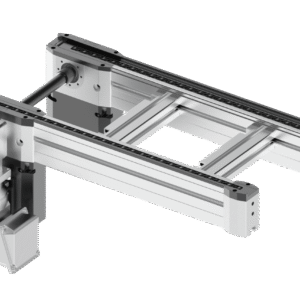
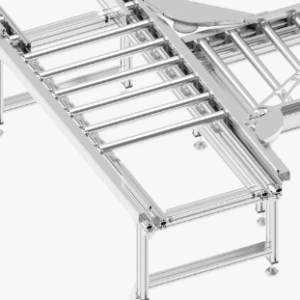
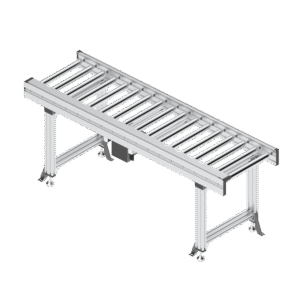
What actually causes pallet knocks — symptom by symptom
| Symptom | Likely cause | Fix |
| Loud knock when a pallet joins the queue | Pallet arrives at full line speed and hits a stationary queue — no speed reduction or cushioning before contact | Damped (pneumatic cushion) stoppers; slow the approach zone; sensor-controlled release so pallets creep the last distance |
| Dented pallet edges over weeks | Line pressure: in one long accumulation zone, every queued pallet is pushed by all the pallets behind it, so the first pallet absorbs the whole queue’s driving force, all shift long | Split the zone into zero-pressure zones — one pallet position per zone, each zone stops driving once its pallet is in place, so no pallet is ever pushed by another |
| Workpieces shift on the pallet | Repeated small impacts plus vibration; accumulation force set higher than needed to restart the queue | Turn accumulation force down to the minimum that reliably restarts a full queue (on Vitrans bevel-gear lines it is manually adjustable); check fixture/clamping on the pallet |
| Problems at all 4 stations, not just one | Systemic design issue — one shared accumulation logic and one force setting for the whole 12 m | Zone each station independently; accumulation frequency per station, not per line, should drive the settings |
The lesson this case teaches: accumulation quality is decided by zone logic, accumulation force and stop cushioning. The drive type sets the ceiling for load, noise and maintenance — but a chain or gear line with one long pressure zone will knock just as hard as an O-belt line. Keep this case in mind through the comparison below: select the drive for your load and environment, then design the accumulation properly for your frequency.
1. How an Accumulating Roller Conveyor Actually Works
Accumulation means the main drive runs continuously while pallets queue in designated zones without stopping upstream or downstream stations — an internal buffer inside the line. When a downstream station is busy with assembly, transfer or rotary work, upstream pallets stop and wait in order; when it releases, they move on in sequence.
The mechanical difference from an ordinary roller is the connection between the drive element and the roller barrel. On a standard roller, sprocket and barrel are fixed and rotate together. On an accumulating roller the connection freewheels: when the pallet is held, the drive element keeps turning while the barrel stays still. That slipping interface is also where accumulation force comes from — how hard the roller still tries to push a held pallet — which is why its adjustment matters more than most buyers realise (see the case above).
2. Three Drive Types Compared
Compare on load, environment and accumulation frequency together — never on one indicator. Load ranges below are typical industry ranges, not Vitrans ratings; Vitrans-specific figures are in Section 3 with their sources.
| Comparison item | O-belt drive | Sprocket chain drive | Gear drive |
| Principe de fonctionnement | Motor drives the first roller; O-belts link each roller to the next, turning the line in sequence | Motor drives a sprocket; a chain connects all driven sprockets so rollers turn in sync | Motor drives the first gear (or a main shaft with bevel gears); gears mesh in sequence for synchronous rotation |
| Avantages | Quiet, simple structure, low cost, easy on-site maintenance | High load capacity, tolerant of dust and oil, stable synchronisation | High transmission precision, excellent synchronisation, strong load capacity, oil-resistant, suited to precise positioning |
| Limitations | Belts age and break; limited load ceiling; slips in oily environments | Chain stretches — tensioning travel required; regular lubrication; costs more than O-belt | Strict alignment requirements; misalignment wears teeth; higher purchase and maintenance threshold |
| Typical applications | Under ~50 kg per piece, clean environments (electronics, packaging), low accumulation frequency | ~50–2,000 kg per piece, dusty/oily environments (automotive, heavy industry), synchronised conveying | High-precision positioning and heavy, high-synchronisation projects with the budget to match |
3. What This Looks Like in Vitrans Practice
Two verified reference points from the Vitrans range (product pages checked November 2026):
Le heavy-duty stackable roller conveyor uses a gear + king shaft drive: 4,000 kg total load, 100 kg per roller, stainless rollers — the gear-drive column above, applied to heavy pallet sections.
Le Vitrans heavy-duty roller line uses a bevel-gear main shaft drive avec manually adjustable accumulation force: 4,000 kg total load, up to 200 kg per roller set, low noise and simple routine maintenance with little lubrication work. Its published application cases are exactly this article’s territory: an automotive battery PACK testing line where each pallet carries 450 kg across 21 heavy-duty stations with lift-and-locate, transverse transfer and rotation; and an automotive motor assembly line conveying 300 kg workpieces with heavy-duty lift-and-locate tables and rotary fixtures.
Two honest limits from the same product page, because they affect selection: this bevel-gear line is designed for dry, clean environments, et repeated reverse running is not recommended. If your line is oily or reverses constantly, the chain column is your starting point, not the gear column.
Typical accumulating-line scenarios beyond these cases: automotive body, chassis and gearbox conveying with mixed multi-model production; buffer storage ahead of sorting in logistics; appliance and motor assembly where stable positioning matters; and multi-station circular layouts with lift-and-locate, transfer and rotary modules for long continuous runs.
4. Practical Selection Guidelines From Field Engineers
Gear drive
Alignment is everything: misalignment wears teeth. Budget for proper installation and commissioning, not just the hardware.
Lubricate on schedule; “low maintenance” is not “no maintenance”.
For very high-frequency accumulation, confirm the friction/accumulation interface is specified for it — do not assume.
Poor cost-performance on light-duty projects; a 30 kg line rarely needs it for load reasons (the motor-line case above needed zone logic, not a stronger drive).
O-belt drive
Inspect belts on a schedule and replace before ageing failure — a snapped O-belt stops one roller and skews every pallet after it.
Tension is a narrow window: too tight damages bearings, too loose slips.
Keep pulley grooves clean; oil contamination is a transmission failure, not a nuisance.
Not recommended for high-frequency accumulation.
Sprocket chain drive
Lubricate regularly; chain wear is faster than the other two and is normal, planned-for wear.
Chain stretch is normal — leave enough tensioner adjustment travel in the design.
Sprocket alignment decides whether you get jumping teeth.
For high-frequency accumulation, add friction plates to the sprocket scheme and calibrate their torque — this is the setting that decides knock severity.
All three drives
Specify zero-pressure zoning wherever pallets queue against each other, and state the accumulation force in the quotation. These two lines in the spec prevent the motor-line case; the drive name alone does not.
5. FAQ
Q: Why do some accumulation stations use O-belts and others sprocket chains?
Load, environment and accumulation frequency. O-belt for light loads, clean conditions and infrequent accumulation; sprocket chain for heavy loads, dusty or oily environments and frequent accumulation.
Q: Gear drives have the best synchronisation — should every high-precision project use gears?
Not necessarily. Gear drives carry higher installation and commissioning costs. For standard accumulation without extreme positioning accuracy, bevel-gear or sprocket-chain schemes usually balance better.
Q: What is the biggest pitfall at high-frequency accumulation stations?
Choosing the drive and neglecting everything around it: friction-plate torque calibration, stop cushioning and zero-pressure logic. The motor-line case at the top of this article — 30 kg parts, dented pallets — happened with load capacity to spare.
Q: How do we stop pallets knocking during accumulation?
In order of impact: (1) split the accumulation into zero-pressure zones so no pallet is pushed by the queue behind it; (2) reduce accumulation force to the minimum that restarts a full queue; (3) fit damped stoppers and slow the approach. If all three are done and knocks remain, then look at the drive interface.
Q: What is the difference between bevel-gear drive and ordinary gear drive?
Bevel-gear schemes drive through a vertical main shaft — compact structure, low noise, little lubrication maintenance (the Vitrans heavy-duty roller line in Section 3 works this way). Ordinary spur-gear schemes can reach higher precision but are harder to install and align.
6. Why Accumulation Matters: Four Values for the Plant
Balancing tact differences — when upstream and downstream speeds differ, the accumulation zone stores the surplus and feeds the shortage, keeping the whole line’s rhythm.
Flexible buffer capacity — output spikes, a short equipment stop or a rush order are absorbed by the buffer instead of stopping the line.
Parts wait for workers, not the other way round — workpieces arrive and queue at fixed stations, so operators work continuously instead of fetching material.
A bridge to automation — accumulating lines connect cleanly to AS/RS, robotic palletising, AGV/AMR and sorting systems, with accurate routing between them.
Clôture
Un accumulating roller conveyor earns its place through buffer stability, integration capability and how well it adapts to your product — not through a price comparison. In new energy and automotive components especially, an unstable line creates hidden downtime and workpiece-damage costs that dwarf the equipment price difference. Choose the drive for your load and environment, design the zones for your accumulation frequency, and ask the supplier to put the accumulation force and zone logic in writing.
Working on an accumulating line? Send us your workpiece weight, line length, number of accumulation stations and environment — the four inputs from the case at the top — and our engineers will return a drive recommendation with the zone layout. Talk to the Vitrans engineering team.