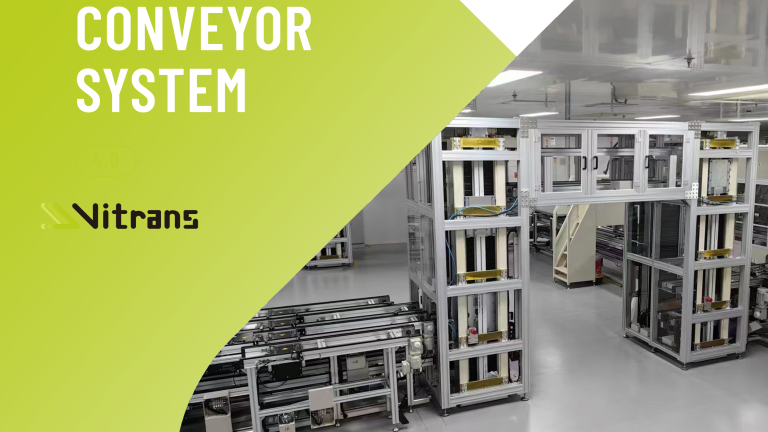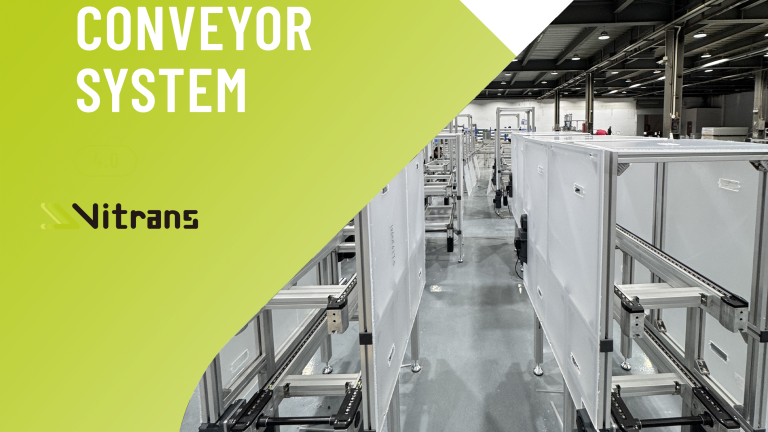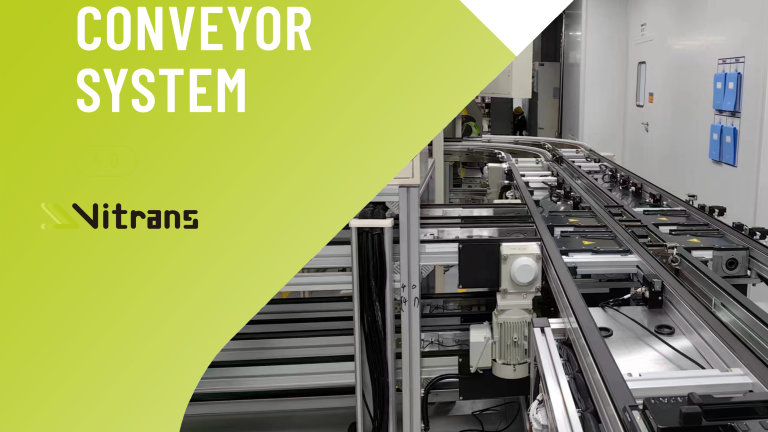











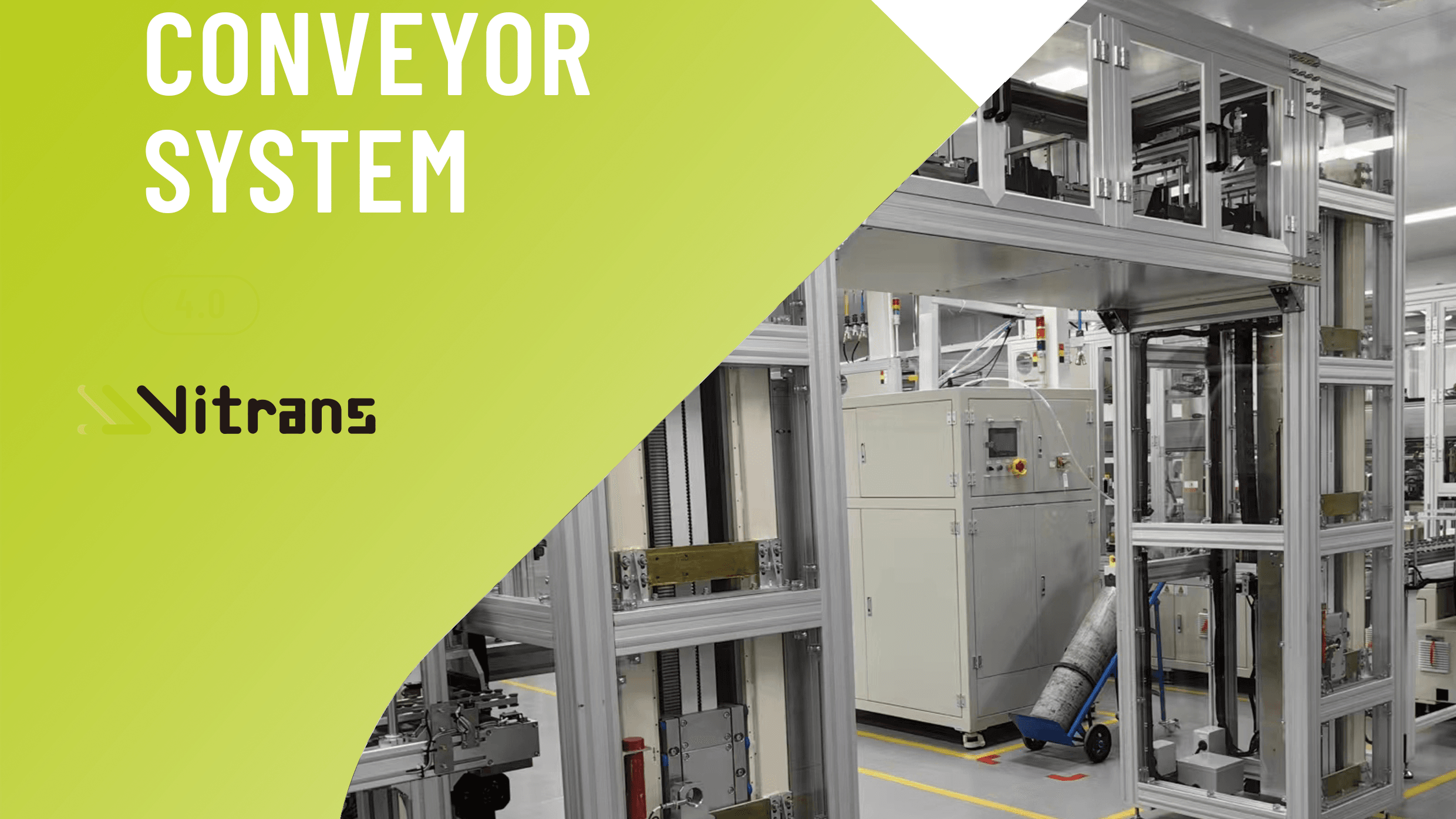
In 2026, stepping lifters act as core vertical transportation equipment for pallet transfer between upper and lower production lines. Their running stability and failure rate directly determine workshop output, downtime losses and overall manufacturing costs.
Lifter suppliers vary greatly in craftsmanship and material quality across the market. Many factory operators have encountered troublesome issues: jamming between connecting sections, frequent system alarms, dimensional mismatch after on-site installation, and slow after-sales support during breakdowns. This article focuses on Vitrans Automation LP/X Stepping Lifter, offering practical purchasing guidance for factories sourcing conveying equipment in 2026.
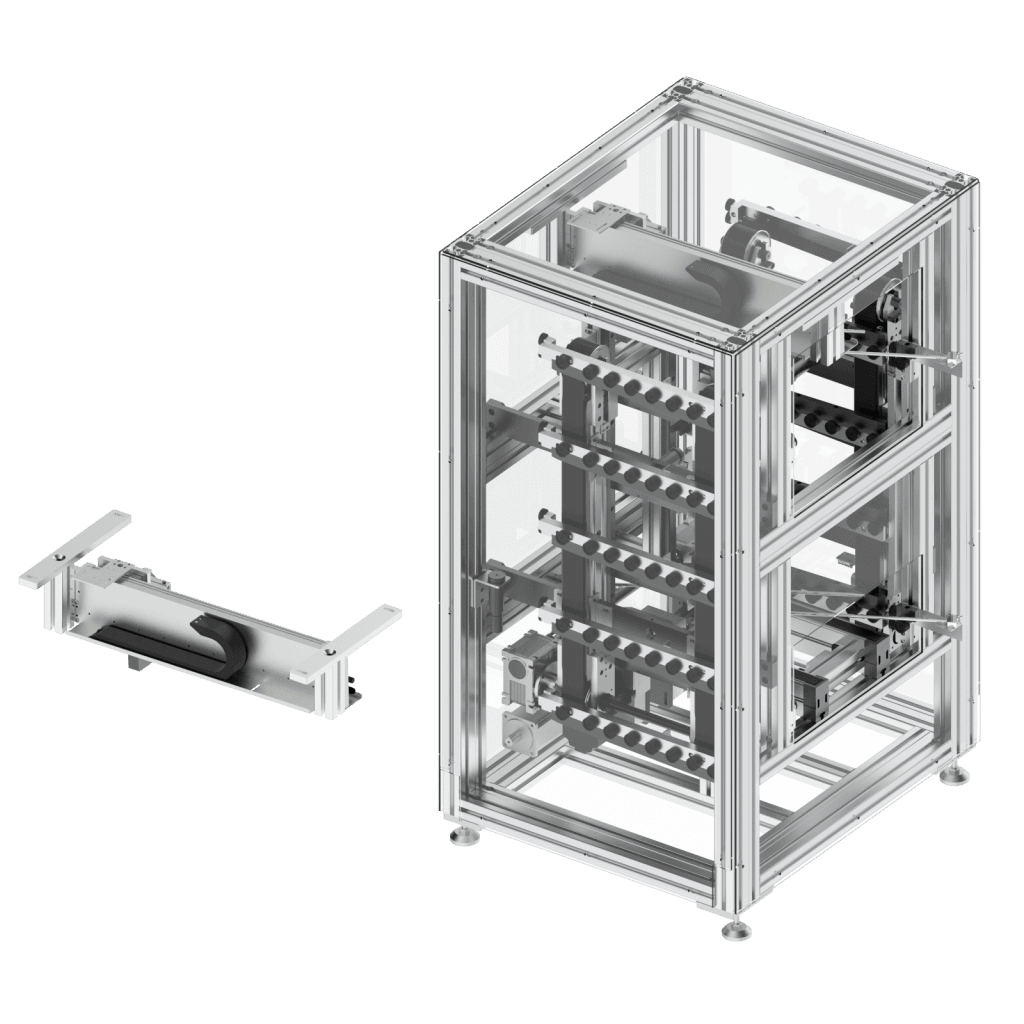
1. Operating Principle of the Stepping Lifter
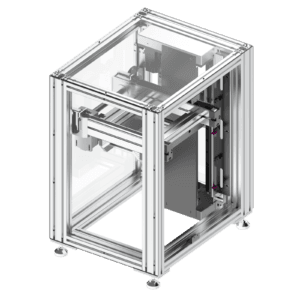
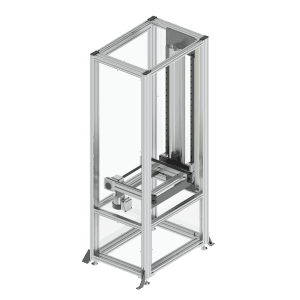
The LP/X Stepping Lifter splits the complete lifting stroke into multiple independent conveying units and transports pallets in progressive steps to shorten each operation cycle. It supports simultaneous feeding & discharging at upper and lower stations for bidirectional material handling.
Multiple sets of unpowered rollers are installed on both sides of the frame, driven synchronously by servo motors. There are two main operating modes:
- Top-in & Bottom-out Mode: Pallets slide into the lifter by inertia, while the internal timing belt conveyor discharges pallets toward the lower line. Feeding and discharging proceed concurrently to maximize conveying efficiency.
- Bottom-in & Top-out Mode: Pallets are conveyed into the lifter via the internal timing belt, then pushed out to the upper conveyor by a dedicated pusher mechanism.
A timing belt conveyor is equipped inside the lifter as standard for smooth movement, effectively preventing pallet slipping and deviation.
2. Complete Hardware Configuration
Pallet Size Adaptability
Applicable pallet width & length: 160mm~640mm (standard increment: 80mm), non-standard customization available on demand.
Calculation formula for internal conveyor length: L = Lwt + 150
Load, Floor Height & Operating Parameters
- Max total load: 30kg; single-layer maximum pallet load: 10kg
- Standard layer spacing options: 200mm, 250mm
- Applicable floor height difference: 350mm ~ 1600mm
- Maximum lifting speed: ≤ 500mm/s
- Optional conveyor speeds: 0 / 6 / 9 / 12 / 15 / 18 m/min. No drive motor will be fitted if speed is set to 0; customized speeds are supported.
Drive System
- Lifting host: Pulse servo motor with driver, equipped with 5m standard cables, single-phase AC 220V power supply
- Internal conveyor: Stepper motor + I/O driver, DC 48V, 3.8A power supply
- Motors can be mounted at middle-left (ML) or middle-right (MR); power specifications can be adjusted according to workshop conditions.
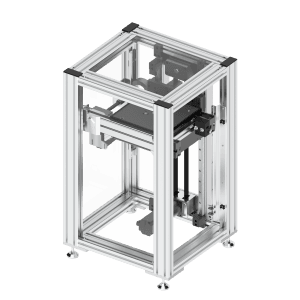
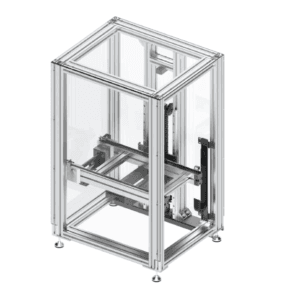
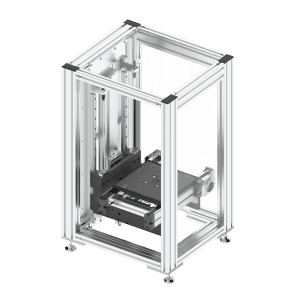
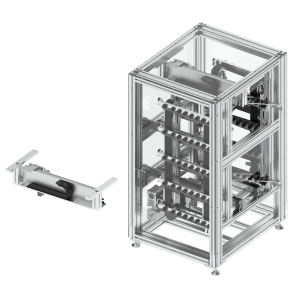
Pusher Cylinder Assembly (for bottom-to-top conveying)
- Rodless cylinder bore: 25mm; rotary cylinder bore: 50mm, thrust: 120N
- Recommended operating air pressure: 0.4 ~ 0.8MPa
Sensor System
- All sensors come with 2-meter wiring, NPN type by default
- 1 slot photoelectric sensor for origin detection to provide reference signals
- 3 pairs of through-beam photoelectric sensors: 2 for pallet in-place detection, 1 for monitoring interlayer gaps. The lifter locks lifting action automatically if retained pallets are detected to avoid mechanical collision
- 2 proximity switches to monitor opening/closing status of safety stoppers
Standard & Optional Accessories
Standard delivery: Main lifting unit, 2 sets of drive motors, full sensor set, safety stoppers, transparent protective cover.
Optional add-ons: Stopper cylinders, 5/2 double-control solenoid valves. The pusher cylinder assembly (equipped with 4 magnetic switches) is recommended for bottom-to-top conveying layouts.
3. Easily Overlooked Mandatory Selection Rules
- Supports single or multiple pallets per stroke as well as pallet accumulation, matching production lines with different takt times flexibly.
- Total vertical height difference must be an integer multiple of single-layer spacing; 200mm pitch is preferred in industrial applications.
- Hwt defaults to 100mm if not specified during ordering; Hwt shall not exceed 100mm when layer spacing is 200mm.
- The mounting height of the lower conveyor must be ≥ 350mm above ground; the height difference of the upper conveyor is generally controlled within 1600mm.
- The number of layers must be an integer; total vertical drop = number of layers × single-layer spacing.
4. Common Procurement Pain Points & Practical Solutions from Vitrans
Pain Point 1: Standard lifters lack flexibility and fail to match non-standard production lines
Mass-produced standard lifters feature fixed dimensions and load limits, making them incompatible with narrow workshops, special-shaped workpieces and multi-layer circulation lines. Factories that purchase lifters and assembly lines separately often face inconsistent operating rhythms, complicated debugging and higher long-term failure rates. Most remote suppliers only provide online communication without on-site survey, leading to installation mismatch and delayed production after delivery.
Vitrans Solution: Flexible customization free from standard specifications. Our engineers optimize frame structure and operating parameters based on workshop layout, workpiece dimensions, production takt and special requirements such as anti-static treatment & compact stations, adapting to multi-layer transfer of most irregular workpieces.
Suggestion: Prepare workshop dimensions, workpiece specs and line speed data before procurement; arrange on-site survey by our engineers to eliminate installation risks in advance.
Pain Point 2: Slow customized delivery & high loss caused by manual handling
Remote manufacturers extend lead times easily during peak orders, restricting capacity expansion. Manual cross-layer handling brings high labor costs and frequent workpiece collision damage. In 3C electronics and lithium battery workshops, ordinary conveyors lack anti-static structures, resulting in component damage by static electricity and mass scrapping occasionally.
With local manufacturing bases in South China, Vitrans maintains sufficient production capacity to shorten customized delivery cycles.
Case Study: For a new energy component factory, we deployed an LP/X Stepping Lifter paired with anti-static timing belts, anti-fall pawls and static elimination devices. After automatic cross-layer conveying went online, equipment failure rate decreased by 80%, transfer efficiency improved by 45%, and workpiece collision damage was effectively eliminated.
Pain Point 3: Slow after-sales response & high renovation cost
When equipment breaks down for brands from other regions, long waiting times for service engineers lead to full-line shutdown losses. Conventional old lifters cannot be renovated for capacity upgrading and require complete replacement instead. Many small manufacturers cut safety components to reduce costs, bringing potential safety hazards.
Vitrans establishes local maintenance teams to deliver faster breakdown repair, regular inspection and line renovation services compared with out-of-town suppliers. We provide full-lifecycle maintenance, rapid spare parts delivery and one-stop line upgrade services to cut long-term operating costs for factories.
Case Study: For a lithium battery plant in Zhuhai, we designed a pallet conveying system combining LP/X Stepping Lifter and timing belt conveyors fitted with buffer baffles, realizing automatic cyclic vertical transportation of finished battery products under unified PLC linkage control. Our engineers arrive on-site within 24 hours for troubleshooting. The hourly material throughput rose by 60%, and package breakage was greatly reduced.
Fazit
As production line upgrades accelerate in 2026, Vitrans LP/X Stepping Lifter serves as a reliable choice if you are searching for a low-failure stepping lifter supporting non-standard customization, stable delivery and worry-free after-sales service.
During procurement, configure hardware according to workshop environment, material characteristics and industry standards. Prioritize professional manufacturers capable of on-site layout survey, whole-line supporting construction and mature maintenance systems, so the multi-layer conveying system can integrate stably into your automated production lines.